Wednesday, June 27, 2012

Movie Review: Abraham Lincoln, Vampire Hunter


Abraham Lincoln, Vampire Hunter is actually quite a fun movie.  While it does have its parts that it kind of drags, overall it's worth the price you're paying in admission. 

In any case, the story goes like this, and I'll try and avoid any major spoilers.  Lincoln, from an early age, discovered the presence of vampires in the world after he saw his mother be attacked by a vampire his father worked for, and saw her subsequently die from the attack.  When he matured, Lincoln attempted to take revenge, only to have it fail miserably.  He would subsequently be rescued and trained by Henry Sturgess, who teaches Lincoln the ways of the vampire hunter while also imparting on him an important code from which to operate.  Lincoln is sent off into the world, where he later meets his wife, Mary Todd, and subsequently catches the attention of the cabal of southern vampires that secretly holds power in the south.  Lincoln subsequently attempts to find his own way of dealing with the menace, but soon discovers that he cannot completely separate himself from not just Sturgess' methods, but also from the direct action of the vampires themselves.

The movie itself differs in the book in many ways.  Several events are changed in the book, and certain characters are omitted altogether.  The role of Edgar Allen Poe, and even some of Sturgess' functions are delegated to Joshua Speed and William Johnston, two of Lincoln's actual friends and aides.  Both actors are superbly played, although Jimmi Simpson's (Johnston) performance is the better of the two. Mary Todd Lincoln's role is also subsequently raised, and even the ending is altered.  While this may anger some fans of the book, it does make the movie its own unique entity that really must be enjoyed on its own, rather than as a direct companion to the book.  The acting is top notch, as Benjamin Walker does a fantastic role as Lincoln.  While he does phyiscally resemble Lincoln to a certain extent, more so when he has the full beard, Walker makes the role his own.   Rather than simply try and portray the 16th president as the historical caricature that has developed around him, but instead gives Lincoln that solemn feel that surrounded him in his later days, while also showing Lincoln the man, in as much as the story could allow it.   Mary Elizabeth Wanstead also does well as Mary Todd Lincoln, able to portray her with a dose of girlish charm, but also able to channel the same sort of determined constitution that the actual Mary Todd did in terms of supporting her husband.  But the true show stopper here is Henry Sturgess, played by Dominic Cooper, who is able to play the master vampire hunter with a great deal of charm, danger, and a certain sense of wisdom and weariness that comes with the role.

The story is fairly self contained, and one doesn't need to have read the book or have any other background knowledge to understand the book.  There are a few basic vampire laws that are broken throughout the book, although these are typically explained or given a brief mention and then dismissed.  Either way, it's not important, really.  When are vampire movies supposed to be based in reality.  There are a lot of great action sequences and special effects, and the soundtrack is very good, though not memorable in the way others are (such as Hans Zimmer's Last Samurai soundtrack, which remains one of the best soundtracks ever written, in my own opinion.)


There are some weak moments.  The movie did have a tendency to drag at some parts, and the action sequences, while awesome, did have some instances which were a stretch of the imagination.  And there are moments of ludicrousness that do strike you when you realize, I'm watching Abe Lincoln kick some vampire ass, and I love it.  But that's a minor quibble at best.

All in all, I greatly enjoyed ABVH, and would recommend for people to see it.  It certainly does surpass some of the other horrible undead movies that have come onto the market over the past few years (I'm looking at you, Resident Evil).  So head out and enjoy it.  It's an axe splitting good time.

Friday, May 18, 2012

Kerry Wood, And The Career We Were Robbed Of


Kerry Wood announced his retirement today, and after his final appearance during today’s game against the White Sox, he’ll ride off into the sunset, more than likely in a position with the Cubs’ front office or television booth.  Wood will be retiring at the age of 34, in reasonably good health, and with a career that he should be proud of.  He has a career ERA of 3.67, an 86-75 record, 1581 career strikeouts, and is on the short list of having pitched one of the greatest games by a starting pitcher in history.

Still, when you look at how Wood began his career, and how his career progressed, you can’t help but wonder that it should have progressed a lot differently.

When Wood burst onto the scene in 1998, he did so with a thunderbolt.  He pitched 166 innings, struck out 233, won 13 games, and on May 6, struck out 20 Houston Astros, joining Roger Clemens as the only pitchers to ever strike out 20 in a game.  His performance was even more dominant that that of Clemens in that he only allowed a single hit and didn’t allow a single walk.  It should have been the start of an exceptional career, one that would see Wood inherit the mantle of Nolan Ryan as that of the most dominant flamethrower in Baseball.  

Except for one problem.  Wood pitched a lot of innings since dating back to his career at Grand Prarie High School.  Wood was one of the last generations of pitchers that were willfully abused and forced to pitch far too many innings as a developing youth.  He was before the age of pitch counts and innings limits, before parents and agents sought to protect their sons and clients from overcompetitive high school and college coaches.

So it’s probably no surprise that Wood, shortly after making the majors, would get injured, due to the rather archaic standpoint of handling pitchers by his managers at the major league level.  Wood would be overworked and succumb to injury by his first manager, Jim Riggleman, during the 1999 season, after having worked 176 innings in both the regular season, minors, and playoffs in his rookie of the year winning campaign.  And Wood would continue to be injured in various parts of 2000 before showing signs of life in 2001, and possible improvement under Don Baylor.  Indeed, after 2002, having since been joined on the Cubs’ staff by Mark Prior, another bonafide young sensation, the Cubs figured to own the NL Central for the next decade.

And then 2003 and Dusty Baker happened.  Baker was another manager of the old school, who felt that a pitcher should be able to pitch whenever his name was called, and to hell with the consequences.  All this talk of pitch counts, and innings limits didn’t hold much water for Baker.  Never mind that baseball history is littered with pitchers that threw for close to 300 innings in a season, and then never pitched again.  Never mind that the San Francisco Giants, Baker’s previous employer, had several former promising pitchers that would see their careers nosedive under Baker’s watch.  No, it’s safe to say that Baker was either ignorant of the effect of too much work on a pitcher, or didn’t care.  

It should have been safe to conclude from the moment that Baker was hired that Wood was absolutely screwed.  Wood would throw 238 innings that year, more than he had ever thrown in his career, and more than he probably should have.  Perhaps if the Cubs had actually gone on to the World Series that year, maybe the sacrifice of Wood’s arm would have been worth it.  Alas, the Cubs would see their chances die in Game 6 of the NLCS, during with another victim of Baker’s mismanagement, Prior, who was exhausted by his own abuse of his arm, would see the game, and the Cubs’ chances at a title, go out the window.  Wood would gamely try to continue as a starter for another two seasons, during which the effects of the 2003 season would ultimately force him to the bullpen, as he simply did not have the stamina, or the ability, to start.


I suppose, in retrospect, back when Wood first arrived, you got the overwhelming sensation that you were going to be a witness to something special.  Wood seemed as if he was going to be the next pitcher with whom we were going to refer to as having left a legacy, much as we do Cy Young, Nolan Ryan, Roger Clemens, Warren Spahn, Sandy Koufax, Greg Maddux and others before him.  You got the feeling that he was going to leave the game much better than when he entered it.

And in a rather sad and ironic sense, Wood did leave a legacy.  It was by and large the utter destruction of both he and Prior that management and coaching in baseball began to look at the effects of utterly working pitchers’ arms to death.  While there are certain cases in which pitchers are overworked and have suffered injury before it (such as Dusty Baker and Trey Hillman’s destruction of Aaron Harang and Gil Meche’s careers respectively), the sport has moved beyond that of ignorance and tradition and more on preserving and developing an asset properly.  Pitching has been described as the most unnatural motion in nature, and it’s true that there is a high level of attrition in pitching prospects.  That does not mean that there needs to be an added element of negligence involved as well.  You are making an investment; why not do your best to preserve it. 

In 2007, Wood would reinvent himself as a reliever, and had a few solid years as a setup man and a closer before all of that wear and tear would finally lead to today, in which Wood would strike out White Sox outfielder Dayan Viciedo, and would then be removed as he was congratulated by his team mates and would be met by his son as he reached the dugout.  Wood, eerily similar to Ryan’s final bow, would emerge from the dugout, doff his hat to the fans, before riding off into the sunset.

A fine ending, and one that any player would love to go out.  Not many players are able to choose how they leave the game.  For most, it's the game that pushes them out, and leaves us with a memory that is neither pleasant, or endearing.  So, in retrospect, that Wood received such an outpouring of love from his teammates and the home crowd, at the time of his choosing, is a blessing of itself.

I just can’t help but feel that things should have gone differently.

Monday, May 14, 2012

Art Supplies - Which I Use, And Which I Don't


Leadholders

This is my weapon of choice when I’m going to draw.  The leadholder is actually the precursor to the mechanical pencil, and comes in various gauges.  I’ve settled on the 2 mm gauge since it offers the best balance of fine and solid lines, as well as the wide availability of lead.  In terms of lead grades, it features the full spectrum of darkness, ranging from 8H to 9B, and it functions very much like a regular pencil.  You do have to sharpen it with a different type of pencil sharpener, with the varieties looking like a regular pencil sharpener or a small trash can that rotates, and many leadholders do have their rear caps with a integrated sharpener, although I don’t recommend using this except in the case of an emergency.  Some of the other perks of a leadholder are that it has a nice, solid heft to it, giving you some great pencil control, and that the pencils themselves last virtually forever.  I’ve only had one ever break, and I have several leadholders that are over 20 years old and still work brilliantly.  That said, there are downsides to leadholders.  For starters, the market has switched over to mechanical pencils, meaning that you’re going to see very little varieties in terms of new leadholders, although you can still find some out there if you look hard enough, as I did when I purchased my Alvin (in the image above).  Second, if you’re wishing to do something with color, then I regret to inform you that this is not the tool for you.  I haven’t seen any official leadholder colored leads in any variety except for blue, red, and violet, although I have seen a contraption at Hobby Lobby that has colored leads in roughly 2mm.  However, they are great to use, and are my weapon of choice, though again, they aren’t for everyone.

 Mechanical Pencils


Mechanical Pencils are the descendants of the leadholder, and are where the replaceable lead medium is progressing for the foreseeable future, though occasionally you’ll see a lead pencil advanced up to the 2mm gauge (God bless the Staedtler company!)  In any case, the neat thing about Mechanical pencils is that they’re readily available, as is the lead, and they’re absolutely fantastic if you want to make a fine line or do some details.  That is also their largest drawback, as drawing to draw any sort or larger, or thicker line, is going to take several strokes.  Even the largest lead pencil grade, .9 mm, is going to take a lot of time.  Plus, even the more expensive lead pencils are going to wear out and break.  There is colored lead available for it, usually in a small variety of colors, but even then, it won’t be enough for you to try and do much with.  Another downside is the fact that the lead spectrum isn’t wide for Mechanical Pencils either, usually ranging from 2B, B, HB, and 2H respectively.  

 Traditional Drawing Pencils

Traditional drawing pencils are what you usually see sold in stores, and they come in different grades, ranging from 8H to 9B, going from light to dark.   While you do find them sold individually in some art stores, in the mega art marts, they usually come in sets, sometimes in a nice little bag or festive tin.  I have various pencils from assorted sets in my drafting desk drawer, though my favorites are probably the Staedtler and Ebony Blacks (which are almost another creature entirely, but I digress).  These are handy in that you have such a wide range of lead to work with, allowing you to use the harder leads for preliminary outlines and such, before going darker for the detail.  The problem is, well, this can get a bit unwieldy because of the amount of pencil’s you’re going to be carrying.  Plus, despite the presence of pencil extenders, there is going to be a point where the pencil itself is going to be flat out useless or impractical to continue to use.


No image to be found on Google, so Fuck it.

Compressed Lead Pencils

Compressed lead pencils are a different animal from the pencils I detailed above.  In general, they look very different, as they are all one color (it’s lead color), and really should only be sharpened with a pencil sharpener, as trying to use a knife can be incredibly messy (which I know from personal experience.)  That said, if you’re using black, you get some of the darkest blacks that you’ll have available in pencil.  When you’re drawing with these, you get a very sketchy sort of drawing, with very little defined detail unless you’ve sharpened the pencil, and even then, you’re likely to see that pencil tip disappear in very short order.  All in all, these are nice to use.  I mess around with them on weekends.

Charcoal

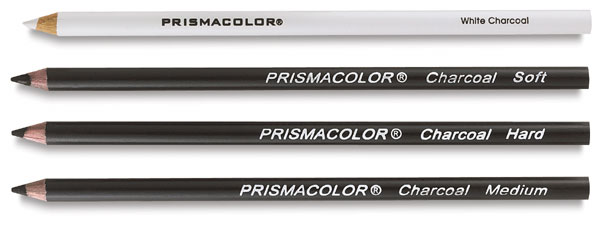
Charcoal comes in a variety of forms, aside from the briquettes that you use to grill on weekends.  I’ve seen them in pencil form, long whisps, and blocks.  In regards to their artistic use, they allow you to get some really dark blacks and some interesting effects regarding light and shadow.  The only problem is that they can get really messy, so you have to watch with smearing.  These really aren’t for me, although I do have a carbon black pencil that I do use for accents and the like.  But some people are able to use them, and are phenomenal with them.

 Pastels

Pastels really are just pieces of colored chalk that you can use to add and blend color onto a piece of newsprint (which it works really nicely on), or which ever paper medium you choose.  There are several benefits to using pastels as an art medium.  The most obvious and major reason why people like to use them are that they are available in such a variety of colors, allowing you to create some really beautiful, eye popping pieces.  They also come in a version that is oil based, allowing you to take a brush with some thinner and allow you to blend it, like paint.  The downside of pastels that I have found in my personal experience is that doing detail in terms of a small scale is difficult, if not impossible, so you have to go big in terms of a piece, although it's possible that this could be different if you are using a pastel pencil.  The other major downside that I've personally found it is that you get that chalky sensation when you use it.  *shudder* But that said, people do like them and can create some beautiful works with them.  One of the versions of The Scream was done with pastels.


Art Sticks (or Stix)
This is another variation of the pastel approach, only this time, rather than like chalk, these are made from the same cores as Prismalcolors colored pencils.  I have purchased some of these and found them to be quite pleasing to use when I want to add some color to a sketch.  They have almost all of the benefits of pastels, but this time without that chalk use sensation.  They give you some rather lovely shades of color, in particular the blues.  The downside to these are, again, the detail aspect, which could be solved by using just a regular colored pencil, and the fact that, unlike pastels, which come in almost any color in the spectrum, there are only a select number of colors that art sticks come in.

Thursday, May 3, 2012

Movie Reviews By the Insane: Hambre Juegos! (Better Known As the Hunger Games)


Well, after a lot of procrastination and a busy work schedule, I was finally able to get enough coherent thought (or something close to it) to be able to put together my honest thoughts about the Hunger Games.  

The Hunger Games is set in a dystopian future where parts of what was the United States are reorganized into different districts in a nation called Panem.  Each district specializes in one specific task, be it mining, electronics, whathaveyou.  All the districts supply the Capitol.  Due to a insurrection years before the start of the movie, the districts are forced to send, every year, a boy and a girl from the ages of 12-18 (I think) are sent to the Capitol, where they are paraded in front of a live telecast with all the pomp of the Opening Ceremonies of the Olympic games, given an NFL/Navy SEAL type of two week training regimen, then sent into the arena after living said two weeks in the lap of luxury, where they are forced to fight to the death until one survives.  Fun times!

My three sentence review:  I liked it!

My much more long winded thoughts?  See below.

Wednesday, April 11, 2012

Hootie And The Blowfish, and The Sophomore Album Curse


When Hootie and the Blowfish first exploded onto the scene back in 1995 (and by exploded, I mean along the lines of an atomic bomb, they arrived on a scene that was ready for something different.  We had survived grunge music, and were preparing to embark on a road of 90’s rock that would produce some memorable bands (like the Goo Goo Dolls, Smashing Pumpkins, and several others) and some not so memorable one hit wonders (like Eagle Eye Cherry and Tonic).  All that was fun about the 90’s, for me, would be captured when I went to see the MP3.com tour, headlined by the Goo Goo Dolls and Tonic.  It was an inexpensive show, and was perhaps the last time the Dolls, Tonic, and MP3.com were all relevant. 
In any case, Cracked Rear View is a very fun album, filled with catchy tunes (Hold My Hand, Only Wanna Be With You), some deep tunes (Time, Let Her Cry, Goodbye), and gave the world a bit of sort of a preview of the later indie folk-country revival that would begin in the mid-aughts.  Hootie was everywhere, playing sold out tours in huge venues, making appearances in various TV shows, and playing assorted music award shows.  I even remember seeing them on a shipment of spiral notebooks over at Target one day, right next to the ones for the Mighty Morphin Power Rangers (and I mean the original ones, not the numerous spinoffs that bastardized the name) and those Lisa Frank notebooks that made you wonder if the makers had at some point taken acid before sending these things out to mass production.  But to summarize it, Hootie was a phenomenon, and a profitable one.  All that it needed to sustain itself was a capable sophomore album. 

So when Hootie's second album, Fairweather Johnson, finally hit stores, there was very high expectations.  But really, it really had several factors running against it's success.  There was no way that this album would ever match the prior albums sales, which for the longest time was the second highest selling album since Pearl Jam’s Ten.  I have to believe that industry execs knew that. 

As you all well know, sophomore albums can make or break a band.  In my opinion, there really are two sophomore albums that result in success.  The first is an album that builds slightly off of your critically acclaimed, but modest selling, debut.  It more or less has to show growth, progress, a bit of a tune up before your have you monster hit that launches you into superstardom.  A good example of this is U2’s October, which is a perfect bridge between Boy and War, the latter of which is U2 finding their voice and unleashing it onto a unsuspecting public.  Seeing as how Hootie already had found their distinctive sound, this result was unrealistic. 

The second sophomore album is the modest comedown album.  After you have your first real big album, or monster hit, depending on the result, this one results in a slight comedown from the prior album.  However, the album must have it’s moments to shine, but still provide a solid enough bridge for the band to have continued success on the next album. A classic and a modern example of that are Give ‘Em Enough Rope by the Clash and Neon Bible by Arcade Fire.  Both were good, but not outstanding albums, especially when you consider their predecessors.  However, both had enough good moments to keep the band’s momentum enough that their subsequent albums, Sandista! And The Suburbs, had their monster numbers.  But again, it must be stressed, the album has to have it's moments to shine, have to offer something to keep people coming back for more.  This is what Hootie And The Blowfish had to accomplish with their second album.

And, sadly, Hootie fumbled the ball on this one.  

This album is bad.  Really bad. As in, you couldn't sell a copy of the CD for a dollar at the now defunct FYE stores because they were flooded with it bad.  (Speaking of which, you have to argue that this program may or may not have resulted in the downfall of the dedicated music store.  It was designed to allow for a healthy market in used, but sellable cd’s.  Instead, what they got were mountains of crap that people were embarrassed to own now, or had only bought because of the one song.  The result?  Mountains and mountains of unsellable stock, with only a few gems to be found amongst the crap.  It’s like a nightmarish episode of American Pickers.)

The album itself starts off promisingly enough with the almost angry ballad Be The One.  It’s dark, a bit angry, catchy, and would have set the stage for a good album.  Sadly, it would be one of the only bright spots of a terrible album.  Many of the songs are slow, unimaginative, and don’t have any of the charm that the songs from Cracked Rear View had to it.  Gone was the introspective tunes like Time, or the happy pop like Only Wanna Be With You.  Instead, you had absolute crap like Tucker’s Town, which was one of the only songs that was passable enough to try and release as a single.  The only other tunes that were worthwhile from Fairweather Johnson are The Old Man And Me, which was the first single from the album, and the album’s namesake, which was meant as kind of a in-between song filler, but instead was a sort of testament to the entire album.  This album felt unfinished; almost like Hootie pulled every B-side that they may have had in some corner of the studio.  Even the Old Man And Me, which is arguably the best track, only resembled a shadow of what was on Cracked Rear View.  These are songs that would be released more on a B-Side album to the original, kind of like what Florence And The Machine did with Lungs.  It feels more and more like the record company, and perhaps the band themselves, hurriedly pushed it together to finish a sophomore album in order to capitalize on whatever momentum the band may have still had. 
And perhaps that is the primary reason why the album may not have done well.  1995 was a vastly different year from 1996.  We were beginning to expose ourselves to newer and different music.  Gangster Rap was on the rise, and we were now in the middle of the East Coast-West Coast feud.  Some of the grunge bands were either reaching some of their biggest heights (like the Smashing Pumpkins) or had died out and were in the process of becoming something new (like David Grohl creating The Foo Fighters from the ashes of Nirvana.)  Hootie had helped us from the transition from grunge and the death throws of New Wave, and now we had rebounded to something new.  Hootie was the poor rebound fling, and now we had recovered from our emotional ruins to rediscover life again. 

With this, combined with poor reviews after the release of the album, and a rising tide of Hootie hate, Fairweather Johnson was doomed.  And while it still sold a rather healthy 3 million copies, the band’s fate was sealed.  Never again did we ever hear about Hootie And the Blowfish as a mainstream band ever again.  They did small tours, and released a couple of albums that did well amongst their small core of fans that remained, and play a concert after the Master’s is finished.  But the band’s career was over.  So far, the only member of the band that could salvage their career in any form was Darius Rucker, who managed to recreate himself as a country singer.

But Hootie and the Blowfish still remain in our collective hearts and memories.  Every once in a while, you’ll hear a song on a dedicated 90’s, or easy listening station.  Most of us still have a copy of the album floating around in our now neglected collection of CD’s that are collecting dust in some forgotten part of our closet.  Still, the album is still a good album, and still is worth a good listen to.  When I make my yearly trip to Albuquerque, I have a four hour stretch of road to look forward to.  And, even though I do have satellite radio, I do pop in Cracked Rear View.  Much as the transition from place to place, the album still has it’s relevance as a way to mark a journey, much as it did during that brief period between grunge and 90’s pop rock.  Hootie came along and gave us something different.  And while you may not want to admit it, you did say Thank You.  Much as you did to the girl or guy whom you turned to for comfort before you moved on.

Thursday, March 29, 2012

A Confession, And A Doorway


I have a confession to make.

And that is that, by and large, I’m a nice guy.

By definition of being a nice guy, that means that I tend to be a fairly affable person, try to be kind, considerate, and personable.  I try and treat others with humanity, and be the best type of person I can be.
And that works well, in particular for other people.  For myself, not so much.  And that is partially my fault.  In my eagerness to try and be kind, try and be helpful, try and do the right thing, I wound up only hurting myself.  I tended to be over eager, too willing to do what the other person wanted to do, and be more of what the other person liked.  The result was often friendships and relationships with people that were more than willing to let me handle the entire load.  And why not?  I had presented myself as being an awfully convenient subservient entity to them.  I was the perfect helot to their Spartans.  And all it really led to was hurt and heartache.

I also have a social anxiety disorder, one which can be paralyzing at times.  It results in me having trouble meeting new people.  As such, time passed, with myself having more and more of a need to meet new people through other friends introduction, feeling more and more alone at social gatherings, and a feeling on inadequacy, as I would look at a group of friends I wanted to approach and join in with, or at a particular woman who caught my attention, but couldn’t muster up the courage to approach her.

And this lasted for fucking years!

After my most recent heartache, which I am still attempting to move past, and am having a fair amount of success on doing, I decided to start trying something else.

I decided to change….or at least, try to change to a certain extent.  I cannot change completely who I am.  In a way, that would be murdering myself, which would be a tragedy of sorts, because I actually am happy with the type of person I am, my interests, and most of my ambitions and plans for my future.  And that isn’t the problem.  It’s how I act around people, and how I approach them.

The first item on the agenda is to overcome my social anxiety.  I’ve been approaching, introducing myself to random strangers, and by and large discovering that my irrational fear of being loudly and verbally rejected is not the case.  Rather, a good many people are actually like me: fair and decent.  Granted, some of them are bastards, but the good comes with the bad.  It all depends on focusing on the good, similar to when I’m doing a sketch and see a line, a curve, a shape that works, and ignoring or eliminating the bad, which is when I erase something that doesn’t work.

The second is to be less accommodating.  Be a little more selfish in terms that I should only extend help to those that deserve it, and try not to go out of my way for someone, not when it’s completely unnecessary, or for a reason that isn’t simply altruistic or genuine.  Simply put, I should do it either because I really love that person, or because it's good for the soul.

And so, here I go.  I'm going to try and rewrite my own personal script of sorts.  And I'll be sharing the progress, observations, and other adventures and shenanigans here.

Monday, March 26, 2012

My Continued Infatuation With Oh My Goddess!


When I was a stupid teenager, I fell fast and hard in love with anime.  It wasn’t hard to see why, as American animation, save for the DC Animated Universe, was in severe decline, and still is to a certain extent, no matter the amount of effort [adult swim] tries to convince you otherwise.  There was also a huge amount of exceptional anime out when I was in my teens as well.  I had my choice between the Gundam series, Neon Genesis Evangelion, Rurouni Kenshin (the Samurai X mini-series remains my favorite bit of animation ever made), as well as any number of other quality programs.  The original Dragonball series was beginning to hit in Mexico, and was a fun program, and even it’s much darker and less plot concerned successor, Dragonball Z, was excellent with it’s Spanish voice acting.  Ranma ½ was a quality series, and two other series, Hanna Yori Dango (Boys Before Flowers, which could outdo any English teen drama in terms of plucky heroines and social issues) and Trigun, which was really the last great anime I watched.  Oh, it was fun times, and great series’, many of which were watched with my little sister, who enjoyed the heck out of these programs as well.

Then, well, everything went to hell.  Several successor programs coming out of Japan began making their way here, and really, once the focus began to shift more on merchandising, and less on content, the quality of anime making its way over just crashed.  I also grew older, and found many of the series’ coming out to be more focused on cheesecake and fights than on the story (I’m looking at you, Bleach!)  Eventually, I returned to the world of comic books, which had greatly improved since my teenage years, and abandoned the world of manga and anime altogether.

Except for one series, which remains a must follow for myself, even today.  Kosuke Fujishima’s masterpiece, Oh My Goddess!

Oh my Goddess, to put it bluntly, follows the story of a young college student, Keiichi Morisato, who accidentally calls the Goddess Relief Line, and given the opportunity to make a wish for anything he wants.  He accidentally winds up wishing for his goddess representative, Belldandy, to stay with him forever.  The wish is granted, and throughout the rest of the book, it details Keiichi and Belldandy falling in love, and their different adventures together as the years pass.  They are later joined by Belldandy’s older and younger sister, Urd and Skuld, who cause their own amount of mischief, for their own reasons.

It sounds simple, sounds so lame, and yet it’s quite engrossing.  Unlike most male protagonists, in comics from both sides of the Pacific, Morisato is an everyman, and not someone who is blessed with exceptional fortune, luck, or powers.  He simply is what he is, and that’s a good man who seeks to persevere and follow his dreams.  Belldandy is the all powerful, beautiful woman at his side, who is supportive and loving of the man she accidentally remaining with.  The supporting cast have their wacky quirks, but all at their core are fairly decent people, with the exception of the series’ few antagonists.

Like several other series creators, Fujishima pulls double duty in the series, doing both writing and illustrating.  In terms of artwork, you see the progression of Fujishima’s skills as time passes in each issue.  The beginning episodes are rather crude, when you look at them for the first time, and feel very busy.  However, as time passes, you see that constant repition and work have resulted in an ever improving style, and a steadier hand.  When you now look at the more current issues, you see that Fujishima has managed to create a beautiful, simple, but expressive style throughout his works, that feels visually pleasing, and compliments his writing well.

Fujishima’s style, so unique to him, was also one of the main reasons why I started learning how to draw.  The simple and beautiful renditions of Fujishima’s characters was so lovely and so pleasing to the eye, I wanted to see, could I try and do that.  Could I be able to draw similar to this man whose work I adored?  I look back and only say, “Foolish child.  Everyone’s work is unique.” And that was before I discovered other artists who I admired, actually received training on how to draw, and began to have conflicting schools of thought when I drew, resulting in my current hybrid style of work that is still very much in transition that you see in my artpage.

But, in the end, what continues to draw me into reading scanned and translated copies of Oh My Goddess online is that almost cheerful wholesomeness told throughout each issue.  It is, at it’s heart, a love story between two really nice people, and the surrounding people in their lives. While the story can at times trend a bit towards the dark, love does conquer all, and people at their heart are wonderful, nice, caring, and peaceful, in spite of their own little quirks.  And, in the end, it’s that lovely warm, kind little world that I’m drawn back to.  Maybe it’s too optimistic, or too simple, but in the end, it all comes down to one central reason why I continue to hold onto this series, years after I’ve by and large abandoned anime and manga as a whole:

Because I love it.