Wednesday, December 12, 2012

Batman On Film: How Could The Nolan Series Continue?

With the rumors that persist about Joseph Gordon-Levitt possibly being in talks to appear in the rumored to be in development Justice League movie as Batman, in a attempt to tie in both the Nolan Franchises into the project, a la The Avengers, it brings up some thoughts again as to how could the Dark Knight Series could possibly continue without it imploding into a spectacular failure as the Burton/Schumacher Franchise did.

For starters, before I address anything, let me say that I think that Gordon-Levitt would be a solid choice to be Batman.  His character, John Blake, was a capable detective, of above average intelligence, tough, determined, had a unflinching sense of justice, and was more than able of handling himself in a fight.  Provided that people are willing to see a somewhat different style of Batman, I think that he could be quite successful 

While it's possible that there could be a completely original storyline done by Warner Brothers as far as how they could continue the narrative of Batman with Blake wearing the mantle of the Dark Knight, Nolan's films do draw upon the vast and diverse amount of comic book source material available.  With that in mind, here are four different comic book approaches on how I could see any potential Dark Knight sequels progressing.

Jim Lee did the kick ass artwork above, btw.

The Batman Beyond Approach

The most popular approach that has been recommended, and probably one of the more obvious on the surface, is the Batman Beyond approach.  Batman Beyond, set in the future, is the story of Terry McGuiness, who more or less inherits the mantle of the Batman after his own father is murdered.  Guided by a elderly, but still sharp Bruce Wayne, McGuiness learns the role on the fly, over time becoming more and more skilled as his predecessor, and becoming a capable Batman in his own right.   It would work well, as Detective Blake, aside from his sharp detective skills and above average intelligence, doesn't show much in terms of the necessary fighting skill that made Bruce Wayne such a formidable opponent.  While that could be acquired, Blake is otherwise more than able for the mental rigors of being Batman, which is quite different from McGuiness for much of the series.  Plus, with Bale having all but said goodbye to the series, and his Bruce Wayne having appeared to be at peace and happy for the first time in ages at the end of the The Dark Knight Rises, it's highly unlikely that this will be the way to go.  This doesn't mean that the Batman Beyond concept should be ignored, as the series is now regarded to be a modern classic.  The writing is still excellent, the animation is on par with modern series', and it still feels innovative and fresh when viewed now.  It has aged aged remarkably well, and could be a successful film series in it's own right if Warner Brothers decided to go in a completely different direction than a reboot.  Keep this series in mind, and in the meantime, check out the series if you've never seen it before.


The Batman: Reborn Approach

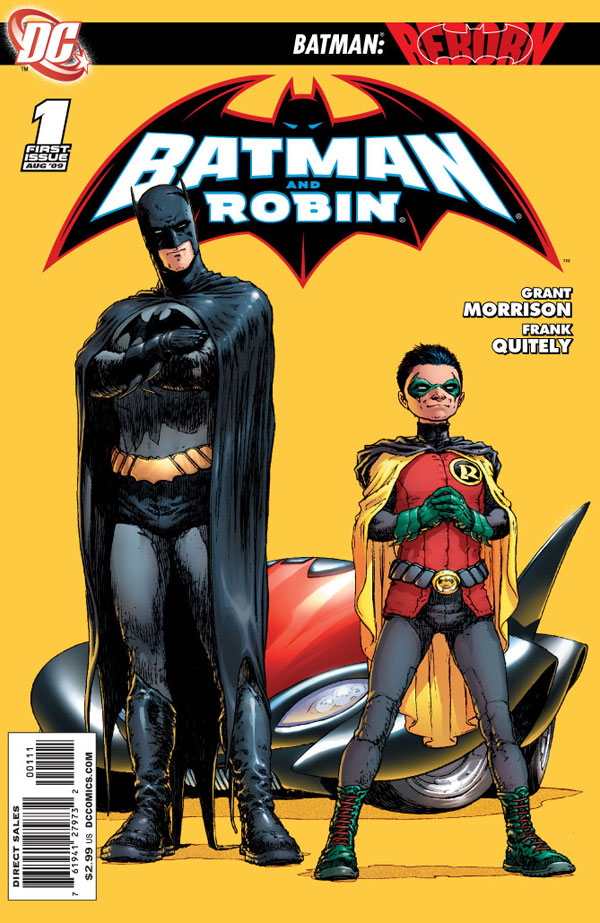
In 2009, after a storyarc that resulted in the apparent death of Bruce Wayne, and a citywide fight in a chaotic Gotham City instigated by Jason Todd, Bruce's fallen Robin, in The Battle For The Cowl, the Batman titles returned to find a new Batman and Robin team gracing their pages, with Dick Grayson, the original Robin, now wearing the mantle of the Bat, and Damian Wayne, Bruce's highly skilled, but violent and socially inept son, now as Robin.  Though the pairing didn't last, as Wayne eventually returned and the entire DC Universe was rebotted after the events of Flashpoint, the concept of a different man under the mask was highly successful, and incredibly popular, much more so than DC's past failed attempt at replacing Bruce Wayne in the failed experiment of John Paul Valley as Batman.

This is probably the storyline concept that would make the most sense, as Dick Grayson was a younger man that respected the legacy of his mentor, but at the same time was not afraid to be his own man.  He had the uniform altered to fit his fighting style, as well as the technology in some cases, and had his own methods for dealing with the police and with the Rogue's Gallery (most notably the Joker, who actually disappeared during Grayson's tenure, only to turn up posing as a masked detective in the UK.)  For the concept to work, however, the writers of the film would have to consult with Grant Morrison, who planned the entire sequence of events leading to Wayne's exit and Grayson's elevation.  Morrison also operates more or less along the lines of Nolan (in my opinion) and wouldn't be afraid to find new ways to modernize and twist up the various Batvillians into the series.   This is my pic for how the series would continue.


The Three Ghosts Of Batman Approach

Another concept for possibly introducing Blake into the role of Batman would be another Grant Morrison concept, The Three Ghosts of Batman.  In this storyline, Batman stumbles upon three masked pretenders, all clad in some variation of his costume.  As the story develops, Batman uncovers that a failed Gotham P.D./U.S. Military Project to train three capable Gotham City cops, one of whom would replace him if he were ever to fall in the line of duty.  It was an interesting, and at times, twisted story, especially when you saw that the mental conditioning and trauma that would normally serve as the drive that kept Batman going had essentially driven the three insane.  It would certainly be a good approach to see in a Nolan series extension, in which Blake, newly operating as Batman, is confronted by each of the three pretenders, whom all seek to take on the role that they trained for, but was given to Blake.  The problem is that it would be an incredibly difficult concept to pull off believable, and as such, the only would who might be able to pull off the concept might be Nolan himself.  Because Nolan has moved on from the Dark Knight, that's not happening.


The Dark Knight Strikes Back Approach
The Frank Miller era of Batman isn't a new source for the Nolan Franchise.  Batman Begins was very loosely based on Batman:  Year One, and The Dark Knight Rises has elements from The Dark Knight Returns integrated into it.  So why not go back to the Miller well one more time, and use the base premise of The Dark Knight Strikes Back, in which Batman, after a hiatus and taking time to rebuild his body, arsenal, suit, and train and army of vigilantes, returns to take down the totalitarian regime that is run by Lex Luthor.   Except in this case, we can simplify it to being just Blake, having taken the time to condition his body in a manner similar to his predecessor, as well as rebuild the arsenal by collaborating with Lucius Fox, returns to Gotham to strike back at a new criminal syndicate that has formed in the absence of Batman.  It would still have the realistic, gritty appeal of the Nolan films, as well as allow for the introduction of other classic Bat villains to take part in the mayhem (Killer Croc, Harley Quinn and even The Riddler all lend themselves particularly well for the Nolan treatment).  It works from a certain point of view, but you would have to have a creative enough director and writer to pull it off.

All in all, there are several ways you can go for reintroducing a Batman into the Nolan Universe, if you are creative enough.  There are infinite amounts of possibilities, provided the director is as inventive enough as Nolan was.  It all hinges on Warner Brothers, the parent company of DC Comics, feeling on whether or not they are willing to go with a Batman without Bruce Wayne.  It would take a great deal of courage to do so, but it could be immensely successful if they so choose to go in that direction.

Tuesday, December 11, 2012

Flick Review: The Perks Of Being A Wallflower

The Perks Of Being A Wallflower

Directed By:  Stephen Chbosky
Starring:  Logan Lerman, Ezra Miller, Emma Watson, Mae Wittman, Paul Rudd, Nina Dobarev, and others

Well, it's been a bit dead around here, mostly due to the madness that usually comes with finals week, but with the week now officially here, I do have some time to kill, so I thought I'd tell you all about a wonderful little movie I saw a week ago. It's been out for a while, and might now still be available in your local multiplex, but if it is, I highly recommend you go catch it.

The Perks of Being A Wallflower is based off of the novel of the same name by Stephen Chbosky. It was published back in 1999, and the film certainly looks the part, with the fashions, music, and settings looking the part. However, it refreshingly go overboard with trying to recreate the period, but goes with just enough of an atmosphere to make it authentic, without making it look cliche. Surprisingly enough, the novel was published by MTV, but you'll be hard pressed to find anything of the mind numbing obtuseness that makes up modern MTV.   Chbosky also directs the film, which means the film's characters, narratives, messages, and storyline stay close to how the author intended it, a true rarity.

The film follows Charlie (Logan Lerman), a quite, intelligent, observant, thoughtful kid who is about to begin his freshman year. However, Charlie himself has his own mental burdens aside from the usual teenage issues, having lost his best friend recently to suicide, and still mourning the loss of his beloved aunt, whose death he still hasn't gotten over. It’s implied that he has sought some counseling over it, but still is troubled by both events. He begins the year a loner, lacking in basic social skills, and treated by the student population and his older sister with a mixture of disdain and occasional torment by the usual douchebags that every high school tends to have.

 This changes when Charlie introduces himself to Patrick (Ezra Miller), an outgoing, hilarious and openly gay student from his shop class, and subsequently falls in with his group of misfits which include Patrick’s stepsister Sam (Emma Watson), a intelligent, music loving girl with a bit of a slutty reputation. Charlie begins to escape his shell little by little as his newfound friends expose him to new and engaging things, including hip bands, the Rocky Horror Picture Show, drugs, and being a part of a group. However, things get complicated over time as Charlie finds struggles to cope with his increasing love for Sam, the weight of his observations about emotional attachment and people, and his own past traumas beginning to re-emerge.

The cast is excellent, and mesh well with one another, giving Charlie’s two families a sense of realism that is natural. We’ll start with Emma Watson, who is the biggest name here due to the Harry Potter films. Watson is endearing as Sam, the passionate 80’s loving emo music nut, something she shares in common with Charlie. However, she is overshadowed by several of the other cast members at times, particularly by Miller. Watson pulls off the American accent well, with only one or two slip ups. Ezra Miller, who plays Charlie’s eccentric, knowledgeable, gay and supportive best friend, rocks this film. He’s charismatic and your eyes instantly fix on him whenever he’s on screen. Some of the best one liners throughout the film are made by him, and he instantly turns every situation into a barrel of laughs, even though he does have his own insecurities that he hides beneath the surface.

Logan Lerman plays the lead as Charlie, and in my opinion, is outstanding. He gives Charlie real intelligence and thoughtfulness, as well as giving the early scenes of him as the shy outcast real believability. He also gives him a sneaky sense of humor, which is almost on par with the outrageousness of Patrick. All in all, he’s great, and a capable strong lead. In my opinion, Lerman seems to have found his niche as an actor. He always seemed miscast in the more action oriented roles like Percy Jackson and The Three Musketeers that he played earlier in his career. But as a thoughtful, cerebral type of actor, he shines.

The rest of the acting is solid, with some big names backing up the kid leads. Paul Rudd is lovable as the English Teacher/Mentor to Charlie. He’s both enough of an authority figure for a student to look up to, while also enough of a confidant for a student to confide in. He’s the English teacher we all wish we had, but very few of us got (I was lucky enough to have two, Mr. Flickenger and Mrs. Avila, respectively.) Mae Whitman, from Parenthood fame, plays Mary Elizabeth, a member of Patrick's group who is sarcastic and pushy, and yet has a softer and insecure side that she keeps hidden. Nina Dobrev, who plays Charlie's sister, Candace, gives a good, but not great performance of a sister who is self consumed in her own problems, but does have a love for her brother that emerges as the film passes. Dylan McDermott plays Charlie’s father, and does a good job, playing a man who genuinely loves and wants to help his son, but is not sure of just how to do so. Even the master of gore effects, Tom Savini, has a small cameo role as an irascible shop teacher that is memorable for the comedic foil that he provides with Patrick.

The music is excellent, bringing back fond memories of the days when friends used to be able to share mixtapes of various music on cassette. The soundtrack features a good mix of 90’s bands, with some classics tossed in for some flavor. The cinematography is good too, giving some great visuals for some of the more memorable moments, such as the tunnel scenes.

However, what I really like about the film is that it feels real, and not staged or fake. The interaction between the group is real and not forced, as are the different moments of awkwardness for the more romantic moments. It also perfectly captures the angst of having a crush on a cool, pretty girl who dates assholes, but without the creepiness that movies usually convey with it. It also has the best quote about why people get involved with people that they shouldn't or don’t deserve to be.

It also genuinely captures high school, in ways that most films fail to do (American Pie and She’s All That being some of the worst offenders.) It captures how tough high school can be for kids that are introverted, or outcasts, as well as the importance of having a loyal, devoted group of friends of the period. It covers how hard it can be to be a gay kid that has not yet come out, as well as how difficult life can be for one that has. It also gives the kids a genuine sense that they don’t all have it figured out, in spite of some outward confidence that they may. But the best part of the film may be that it’s also inspirational from the standpoint of being able to have the courage to open yourself to the world, for the good and bad. It also gives a genuine hopeful message that one can move on from tragedy, or from past traumas that can cripple a person if not dealt with, and that one can lead a happy and fruitful life. So, I highly recommend that you see this movie. It’s funny, it’s inspirational, as well as sweet, quirky and different in all the right ways. It’s a masterpiece, with enough going for it to perhaps even be timeless. I love it.

Sunday, November 25, 2012

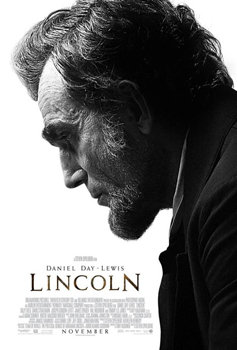
Flick Review: Lincoln


Lincoln (2012)
Directed By:  Steven Speilberg
Starring:  Daniel day-Lewis, Sally Field, Joseph Gordon-Levitt, Tommy Lee Jones, and many more

I saw this movie over the Thanksgiving weekend, so I thought I'd share my thoughts about it with you all.

Lincoln is based partially on the book Team of Rivals, written by Doris Kearns Goodwin.  The book itself is an excellent, though lengthy read, so Spielberg decided to focus specifically on the machinations and behind the scenes work that Lincoln and his cabinet undertook to pass the 13th Amendment.  The pressure is on as Lincoln must try and pass the Amendment as soon as possible, with Republican support for the bill conditional at best, and Democratic support difficult, but weak in certain areas.  Lincoln, throughout the film, must wrestle with being able to convince his supporters and his cabinet to support his cause, while at the same time having to live with the pressures coming from not just the bill, but also the rising cost of lives from the Civil War.

Spielberg did an excellent job of choosing the elements of the book that would make the movie, as well as doing something different when it came to not just the subject of Lincoln, but also of the Civil War.  For starters, Spielberg deliberately does not show much of the actual war itself, although it is mentioned many times over the course of the film.  The only real glimpses of it are at the beginning, with the soldiers marching out to deployment, and at the end, when Lincoln himself tours a battlefield on the way to meet General Grant, giving him a full glimpse of the scale of the entire conflict.    Spielberg also makes mention of the assassination of Lincoln, but instead chooses to go in another direction for showing the shock and horror of the moment when the news breaks that Lincoln has been shot.  It's highly effective, and heart wrenching at the same time.

There are some really great visuals in the movie, the best of is Lincoln's final scenes in the White House as he exits to head to Ford's Theater, where we seem the final glimpse of Lincoln: the Man before he becomes Lincoln: the Ideal.  Another great scene is Lincoln giving a speech in the Union Telegraph office, which goes well for all except for an overly serious Secretary of War Stanton.  It's really one of the highlights of the film. That same office would later be the sight of one of the greatest scenes from the movie, as Lincoln broods over a possible choice that would change the course of the war, with the office dimly lit, and Lincoln looking larger than life, but strained and worn, as if the past four years had eaten away at his being.

What helps make this movie go, and probably makes it, is the casting.  The senators are all well cast, although I did agree that the two principal senators of the democratic side came off a little too much like the evil Colonel Sanders type of slave owners for my taste.  However, the rest of the senate is well casted, with the different factions, as well as those senators that are on the fence as far as their beliefs or desires regarding slavery, all well acted.  The scene in which the Amendment is voted on is a riveting watch, and it's wonderful to see each Senator, including the fence sitters, vote and their expressions and reactions as they make their historic choice.  There is one particular senator that stands out:  Tommy Lee Jones as Senator Thaddeus Stevens.  Jones is his usual cantankerous and fiery self as the Republican Senator that believed in true equality for all races, and was not satisfied with the Amendment as it was, but would support it nonetheless.  And yet, despite his fire and anger and crankiness, you get a sense of genuine goodness and a strong sense of moral justice from Stevens, and you get a true reason for why he fought so hard for true equality at a time when the ground was still tough and hard.  

Lincoln's cabinet was well casted as well, but I'll focus on the two chief leads, Secretaries Seward and Stanton, played by David Strathairn and Bruce McGill.  Seward was the chief mover and shaker, and did a lot of Lincoln's (and later Johnson's) dirty work when it came to wrangling support for his policies.  However, you get a sense of true loyalty to the President, as Seward was always conscious to make sure that the President stayed as far away as possible.  Stanton is fairly accurate a serious man with a dedication to his duty, although I do wish it did make mention of the fact that Stanton was devastated at Lincoln's death and reportedly wept bitterly during the President's final hours.  It was Stanton himself that launched himself into the quest to capture John Wilkes Booth (which is told in the film The Conspirator, also a great film), although his now famous quote of "Now he belongs to the ages" does make the cut.

Sally Field did a solid job as Mary Todd Lincoln, showing herself to be a devoted wife, and a charming First Lady when need be, but also was able to show off some of Mary Todd's mental instability that she is known for, most especially when her son Robert (played well during his limited screen time by Joseph Gordon-Levitt) decides to enlist, and is angered at her husband's seemingly callous acceptance of it.  It's a great scene, and one in which it shows the Lincolns were just as human as we are, as opposed to the stereotypes of the Saint and the Madwoman that we have seen over the years.  Sadly, Field is outshined by Gloria Reuben, who plays her maid Elizabeth Keckley.  She gives such a dynamic performance, and gives such a nobility and grace to a character that may otherwise be overlooked, but did in fact have an long lasting relationship with the First Lady that endured with time.  Her two greatest scenes, one with Lincoln and one in the Senate, are more than enough to get her some run for Best Supporting Actress, in my opinion.

Which brings me to Daniel Day-Lewis, who plays the films namesake.   In my opinion, no matter how great the casting, you can never truly hope to recreate a person as they were, as they lived, as they breathed.  It's impossible, and no matter how critics can try and convince you otherwise, its impossible.  However, I do think that it's possible for an actor to at least capture the essence of the character that they are playing, that vital core of traits, speech, look and feel that makes that person, for that period of time, that character's shadow.  And Day-Lewis does that.  You get the feeling that you are watching at least the essence of Lincoln, in all of his greatness, all of his flaws, and all of that dry wit and ever present melancholy that seemed to haunt him in life, and most especially in his presidency.  It's probably the best portrayal of Lincoln to be done on film (although I enjoyed Benjamin Walker's portrayal in Abraham Lincoln: Vampire Hunter), and perhaps even the closest we'll ever get to seeing what Lincoln might have been like in life.

All in all, it's a fantastic film, one that will likely be up for several awards come awards season, and probably an Oscar for Day-Lewis.  But even more than that, it's a look into one of the darker sides of our nation's history, from a different point of view than what is typically shown on screen.  And it provides a bit of a window into the life of one of our favorite and most fascinating people in our nation's history.

Wednesday, October 24, 2012

Flick Review: Dredd

When you mention to people the phrase, Judge Dredd, usually what comes to mind if you are not a comic book nerd, and even then a fairly diverse one, you usually think of the movie starring Sylvester Stallone.  It's not a great film by any means, although it is entertaining in a pure trash sort of way.  I mentioned it in my 10 Awesome Bad Movies post earlier in the year.  It's a great film for just turning off your mind and having a beer or two while watching.

But I really did want to honestly see a great Judge Dredd movie, one which was pure to the original character, and reflected the quality of writing and great artwork that I had seen from the issues of 2000 AD that I did encounter.  So, when I saw that a new movie was coming out, Dredd, this year, I was pretty stoked.  Here was a chance for a possible reboot of a franchise that went so far off it's mark in it's first real outing.

Rather than the huge conspiracy that we were fed in the original Stallone flick, this new one covers Dredd taking a rookie Judge, Anderson (played by Olivia Thrilby, who you may remember as Juno's slutty friend from Juno) out on an evaluation patrol. They receive a call from one of the giant living quarter complexes (200 floors with the population of Las Cruces, New Mexico in each) of a triple homicide. Anderson's psychic powers result in her finding the culprit, who also happens to be one of the top lieutenants to the complexes' drug operations run by Maw-Maw, played by Lena Headley, who owns the role and gives it the sort of menace that is needed to counter the performance of Urban. She has the entire complex shut down, with orders for her gang to murder the two judges. Cut off, the pair of Judges have to fight their way through the floors in hopes of taking down Maw-Maw, and surviving in the process.  

Just to let you all know, this is easily one of the better action flicks to come out this year, forgoing the bloated conspiricy story from the original in favor of a claustrophobic, fast paced thriller that does not let up from start to finish.  The cast is deliberately kept small, and intimate, and because of that, we see enough of a resolution from beginning to end as far as what the ultimate fates of our leads goes to.  It's nice, as there aren't many instances where we wonder, "What, what happened to so and so?"

However, this is a film where, inevitably, it's going to be compared to it's predecessor, the cult classic Judge Dredd, even though it shouldn't.  But, for the sake of argument, let's do a side by side comparison.  The difference between the two films is evident right from the start, beginning with Dredd himself.  For starters, let's take a look at how Dredd is portrayed in the comic.

Not bad.  Slightly ridiculous, but not nearly as much as the appearance of other legendary comic book characters such as Superman, Captain America, or Aquaman.  And still, you can make out some swagger, and an aura of respect surrounding him.  Now let's take a look at the movie portrays from Dredd and Judge Dredd.


Hat tip to Egotastic! for the image

What a difference!  Stallone's appearance is much closer to that of the comic counterpart, but in this case, this is an instance of when an outfit should pay a homage to the original, rather than directly copy it.  In the former's case, Urban's outfit looks functional as an actual set of protective tactical gear, while at the same time having enough of the touches of the original (the enlarged badge, the eagle and shoulder decorations, and the helmet) for him to resemble Judge Dredd.  Stallone, on the other hand, just looks flat out ridiculous, with the overly small helmet (any shorter and it would be a yarmulke), the huge ass shoulder pieces, and what appears to be a damn body suit that lacks any sort of protection what so ever.  Except for the huge codpiece, because seriously, how hilarious would it be for the might Judge Dredd to be taken down by a kick to the gonads.  .

What also helps is that Karl Urban once again takes a character and gives it such a element of life and intensity that he draws you to him when he's on the screen.  Stallone's portrayal of Dredd came off very much like that of a boxer past his prime.  Consider Oscar De La Hoya late in his career.  Sure, you respected him for what he had done.  But you didn't fear him like people might have once had.  And that's how I felt about the original Judge Dredd film, that you never really got the sense of Dredd as being worth the almost reverent type of respect that he received from the other characters.  Urban, on the other hand, owns this role as much as he did when he played Leonard McCoy in Star Trek.  He's a capable lawman, one able to think on his feet as much as go by the book, while also showing a genuine passion for the occupation that he has taken up.  However, unlike Stallone's Dredd, who was pretty much an unemotional brick that remained sealed off until the end of the film, Urban allows for some human emotion and contact, as witnessed with his camaraderie with Anderson.  He's absolutely solid, and is arguably as great a case of casting as Christian Bale and Robert Downey Jr. were for Batman and Iron Man.

Much of the technology also looks the same way, as things are meant to be much less prettier, but much more functional.  We see this in Dredd's weapon, the Lawgiver, which is actually larger in this film than it is in the original Judge Dredd film, but with the weapon's purpose of firing multiple purpose ammunition, this again makes much more sense.  I never got the reason in the original film how their pistol could incorporate all of it's functions in such a small package.  The Judge's motorcycles are also simplified, with the huge, steroid pumped motorcycles that the Judges tooled around in the Stallone film now being replaced by stark, functional, and efficient rides.  Even then, though, I prefer this tech to the one in the previous films.  It's sexy in a useful way.

The visuals on this take on Dredd are excellent.  Mega City One now actually looks more of what you would realistically would picture a city that houses hundreds of millions to look like:  spartan and functional.  This is a no frills city, designed to house and contain.  There are no aesthetically beautiful areas of the city, nothing to inspire or draw the eye.  It's simply housing, nothing more.  Due to the budget, and the approach of the film, we don't get to explore much of the city, which is kind of a shame. I would have loved to have seen what some of the more higher class areas of the city looked like, as well as the desert of the Cursed Earth itself.  That's the one thing that the original Dredd really has over this film, is that it's Mega City One was prettier to look at.  The effects are small, but well used.  There's enough blood in this film to satisfy the gorehounds out there, although to be honest, this is probably one of the things that will keep some away from the film.  There's literally a bloodbank's full of blood shed in this film.  

The effects of slow-mo were shown in the trailers are used several times throughout the film, for good effect. We see a gunfight through the eyes of a slow-mo user, and even Maw-Maw's final fate are used through the effect of slow-mo, during which we are even shown the scale of the standoff between Maw-Maw's gang and the two Judges.  It's well used, even though we also see the large amount of blood at the end that will, again, make some squeamish.

All in all, Dredd is a great film, and one that I would recommend all of you to see.  However, Dredd didn't perform well in the box office, and hasn't made it's budget back, which will likely kill any future sequels, which is a shame.  It certainly deserves to have it's story told further, and there are shittier movies that are out there that have gotten sequels.  What hurt the film, in my opinion, was the Stallone original, which was so bad, and did such a poor job of introducing a classic foreign character domestically, that it left a poor taste in almost everyone's mouths.  And that's a shame, because this is a great flick that deserves a lot more love than it's been shown at the box office.  Give it a chance.

Friday, September 21, 2012

Flick Review: The Expendables 2

The first Expendables movie was a fun romp through memory lane, as the collective bad asses through the 80's, 90's, and Aught's joined together to form a collective group of mercenaries out to fight the dregs of humanity.  It was a typical tried and true 80's movie plot, nothing that we haven't seen in the original Rambo movies, or any of the Van Damme or Schwarzenegger flicks that rotted our brains as we picked them up from the video store.  It wasn't a great movie by any means, but it was entertaining and all in all, a good bit of cheesy fun.

The second Expendables film takes the original film and expands the premise and cast accordingly.  In this film, Barney Ross (Stallone) and his rag tag band of psychopaths (Statham, Lungdren, Crews, and Couture, with a brief appearance of Li) are dispatched by omnipresent CIA man Church (Willis) to obtain an item from a safe with one of Church's best operatives (newcomer Nan Yu).  However, upon the retrieval of the item, a detailed plan for a buried soviet stockpile of weapons grade plutonium, the group is ambushed by mercenary Jean Vilain (Van Damme).  The plans are taken, but the Expendables lose one of their own (hello and goodbye to Liam Hemsworth).  With the grief of losing their comrade in arms, and the embarrassment of having been taken by surprise still stinging, the Expendables head off on a journey of vengeance and mayhem, as they hope to avenge their loss while stopping Vilain from pulling off his deadly nuclear caper.

For starters, let's get the bad out of the way.  This is essentially every nuclear scare movie that those of us who remember the cold war got to be entertained with, with the added twist of the heroes of these movies still kicking ass.  The writing is average for the most part, the villains (especially Van Damme's Vilain) are nothing more than caricatures of every evil mercenary stereotype encountered, and the plot is fairly predictable, with very little in the form of twists.  This isn't Oscar material, in other words.

Thankfully, the film knows that, and doesn't try to do anything more than simply entertain.  And because of that, this is a very fun film.  In terms of the character development department, we get very little, the only real nugget of knowledge being that Ross owes Church a huge debt of service from years before and that Gunner (Lungdren) was a chemical engineer before he went insane.  But beyond that, we simply get to see the Expendables go out and kick ass in predictable, and over the top ways, many of which are beyond the laws of physics.

The best part of the film, and which makes it superior to it's predecessor, is that there is much more interaction between the entire group, while the previous film tended only to focus on Stallone and Statham.  With this addition, there is a great deal more comedy, usually involving Lundgren, Crews and Couture, all of which is at another's expense.  It's hard to describe, but the dynamic is hysterical.  Even Yu, who really just replaces Jet Li as the asian component of the group, is funny, both in terms of her dialogue, and in some of the facial expressions that she makes out of her seemingly genuine disgust of Lungdren's crush on her.

The action isn't just limited to the Expendables themselves.  Others get in the act, namely Van Damme, Willis, Schwarzenegger, and Norris, both in the fighting and wisecracking departments.  Willis and Schwarzenegger are comedic gold during their asskicking sequence, and even trade each other's trademark catch phrases.  Norris is hilariously portrayed as a human force of nature, and even manages to integrate his infamous Norris jokes into his sequence.  And even Van Damme, who really has never played a villain before, does a good job of being rather disgustingly evil and ruthless.  It's almost a shame that he meets his end in the film so permanently.

Overall, it's not a great film, again, but it is a very entertaining one, and worth seeing it in theaters for the novelty of seeing these old codgers kick ass once more, and hearing them drop one liners on each other with the frequency of Caesar's Automatic shotgun.

Friday, August 31, 2012

My Weird Love Affair With Moleskine Journals

Sorry about the absence.  Life kinda got in the way.  Don't worry, I'll be back on my usual tangent of comic books, booze, and movies shortly.  But in the meantime, I'd like to talk about something different.

I like to draw, and when I came back to the hobby around 2008 after a five year hiatus or so, I wanted something different that I could carry around, but not be bulky.  The regular sketchbooks that I would purchase from Target were little more than large, spiral notebook bound piles of almost cardstock, which had the nasty habit of not just smudging, but showing deep lines from where the previous drawing had stood.  It looked awkward, and rather ugly to boot.  Plus, like spiral notebooks tend to do, they would fall apart if they took too much abuse, which mine did while in a backpack.

I discovered the larger, bound sketchbooks over at Barnes and Noble not long after, and found them to be rather spiffy.  They were bound, first off, and didn't have that tenancy to fall to shit after some abuse.  They also had a rather nice quality paper inside, almost like Bristol, that erased well unless you were using some really dark leads.  Plus, they scanned well, which is nice, and they were sturdy for the events when I was doing a life draw, and didn't have a flat surface.  Only one problem:  these were rather massive beasts, and were a bit too large to have around for everyday carrying purposes.

It was at Barnes and Noble, when I was debating about purchasing yet another of the latter sketchbooks when I noticed a display proudly showing off the entire selection of Moleskine journals.  Whether it was due to me really being in need of a solution, or more than likely due to me not having anything else better to do then quest for sketching mediums, I headed over to check them out.

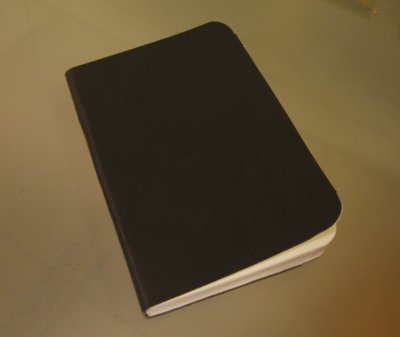
For those not in the know, this was what your basic Moleskine consists of:


It's nothing really special.  It's sixty pages of thin paper, sewed at the spine between two slightly larger pieces of board, usually black, although red, navy, and tan editions also exist.  They also come in different forms, like planners, small sketchbooks, and city guides.  But those are unimportant to the purpose of this blog post.  What I'm speaking of are the journals, which come lined, in a grid, or plain.  And I was excited as all hell when I found the plain.  And I never looked back, and and pleased as punch to say that I now have a stack of completed Moleskines in my studio, all filled to the brim with my mediocre art.

So what is it about these rather remarkable unremarkable sketchbooks that make me giddy?  It's probably because they are just so simply and unassuming, which makes them all the more flexible for one to do what they will to make them each a unique and individual piece.  Aside from the individual art inside, which is as different due to simple time and improvement, the exteriors are usually pimped out with all matter of stickers and assorted items that I encounter in my journeys.  Each sketchbook is a kind of snapshot, a peek into what was in my head, and where I was at the time.  And these sketchbooks are a cool medium to do that.

Granted, they do have their downsides.  They aren't nearly as durable as the other big beasts from Barnes and Noble, both in terms of their build and their paper.  They can't survive an overeager five year old, as I also discovered.  But they are really cool journals, and are more than versatile enough to tag along with me, no matter where I go.  And in the end, that's what matters.

Friday, August 10, 2012

Battle Royale As A Show Would Work Rather Well

Well, the news coming from the weekend was that the CW was in talks about turning Battle Royale into a television series.  While there are questions as far as to just how true to the original novel that the CW would stay, or even if they know what the book is about, turning Battle Royale into a TV series rather than a movie actually would be much more effective medium of translating the book into a visual presentation of the subject matter.  Here's why:

Allows For Fully Fleshed Narrative

The original book, Battle Royale, is not a small book by any means.  It's a rather large and detailed tome that covers the horror and depths of the central characters, and the wider world of the island, within it's handsome red cover.  And while the original narrative has been covered twice in both the movie and in it's subsequent manga, the movie, despite it's attempt to cover almost all of the main events that take place within the book, does have to cut corners.  As Stephen King once said about his truncated version of The Stand, and I'm paraphrasing this from memory, it's like a classic car, but with the paint and chrome sanded off.  It goes somewhere, but it isn't, you know, boss!  And that's how I felt about Battle Royale: The Movie.  The basic narrative of the story is there, with it's highlights, but a lot of the other little details that help develop the book, and allow for what I believe is a more enjoyable experience are missing.  A TV series, while lower budget, does allow for a fantastic medium from which to tell a story.

My favorite show at the moment, Breaking Bad, while blessed with excellent writing, wonderful characters, and great visuals, would still be an incredible movie.  However, it would also not nearly be the gripping thrill ride that I experience week to week if everything was forced to be condensed into a three hour flick.  And while this isn't a bashing of movies by any means, it is an admission that movies, while wonderful, are limited in terms of how much they are allowed to bring out and flesh out their subject material.

Allows For Focus On All Characters

Another great feature of the Battle Royale novel is that every student in the doomed class is given their own moment in the sun, whether it is their own portion of a chapter, or enough of a mention in the narrative that you do get at least a small piece of the person's essence, just enough for you to feel a slight twinge of pain or slight amusement whenever you see or feel that person die in the novel.  And while each and every student is shown whenever they've assumed their end in the film, you don't get that sort of emotional experience that you get in the book.  In the end, they're simply just mindless numbers.

However, in a television series, you would not only be able to show more than just mindless death, but also genuinely get to know each person, get the gist of each student in the class, and be able to mourn and honestly feel an emotional attachment to the characters that we see on screen.  But this doesn't just extend to the characters that are involved in what is called "The Program" in the novel, but also those who are in charge of the event.  From the average soldier that is charged with simply guarding the main fortress, to the parent who has suddenly realized that they will likely never see their child again, to the average man on the street, a television series would be able to weave each of the elements into the semi-voyueristic nature of Battle Royale, allowing for not just great story telling, but also a great way of advancing a narrative.

Allows For Exploration Of Entire Battle Royale Universe

The manga is even more expansive than the novel, with a great deal of original content covering both the characters backstories, as well as the wider world outside of the Program.  It makes for a richer piece of story telling, and allows for the creation of newer characters that don't have a stake in the actual program per se, but could in the future, whether they are in favor or opposed to the purpose of the Program itself.

Going back to Breaking Bad for a moment, the center of the show's universe is essentially the adventures of Walter White and Jesse Pinkman as the two attempt to survive their very dark world of meth cooking.  However, the show is not purely about them, as it often takes detours exploring the other characters of the show, whether it is the struggles of loyal wife Skyler White, the personal vendetta of Gus Fring, the various misadventures of Jesse's fellow band of stooges, to the machinations of Mike The Cleaner and Saul Goodman.  It's more than just the two central characters.  It's the entire ensemble and the whole wide universe that makes the show what it is.  And turning Battle Royale into Battle Royale: The Series would give the narrative such a canvas from which to work.

Allows For Multiple Classes Over The Course of Several Seasons

Finally, what a television series allows is for a series of multiple classes that find themselves victims of the program.  This wouldn't be something along the lines of Saved By The Bell, where we are forced to watch a class over the course of six or seven seasons as the gradually whack each other, but we are instead treated to a single class each season, with the potential for a larger conspiracy that seeks to end the slaughter by the end of the show's run.  It's an absolutely fantastic plot element, and keeps the central theme of the show going, but without the loss of a advancing, overarching narrative that will eventually come to a head in the final seasons.  Overall, it's perfect.

In the end, it all depends on who is placed in charge of the show, how willing the CW is willing to embrace Battle Royale's beautiful chaotic core, and how willing they are to choose not to try and adapt it toward a teen or tween audience (as many of the CW's shows are).  If done right, Battle Royale could be an instant classic.  But that's still a big If.