Sunday, November 25, 2012

Flick Review: Lincoln


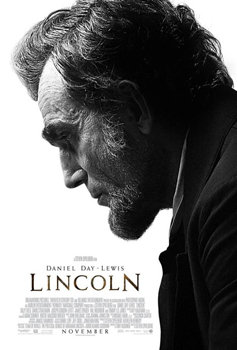
Lincoln (2012)
Directed By:  Steven Speilberg
Starring:  Daniel day-Lewis, Sally Field, Joseph Gordon-Levitt, Tommy Lee Jones, and many more

I saw this movie over the Thanksgiving weekend, so I thought I'd share my thoughts about it with you all.

Lincoln is based partially on the book Team of Rivals, written by Doris Kearns Goodwin.  The book itself is an excellent, though lengthy read, so Spielberg decided to focus specifically on the machinations and behind the scenes work that Lincoln and his cabinet undertook to pass the 13th Amendment.  The pressure is on as Lincoln must try and pass the Amendment as soon as possible, with Republican support for the bill conditional at best, and Democratic support difficult, but weak in certain areas.  Lincoln, throughout the film, must wrestle with being able to convince his supporters and his cabinet to support his cause, while at the same time having to live with the pressures coming from not just the bill, but also the rising cost of lives from the Civil War.

Spielberg did an excellent job of choosing the elements of the book that would make the movie, as well as doing something different when it came to not just the subject of Lincoln, but also of the Civil War.  For starters, Spielberg deliberately does not show much of the actual war itself, although it is mentioned many times over the course of the film.  The only real glimpses of it are at the beginning, with the soldiers marching out to deployment, and at the end, when Lincoln himself tours a battlefield on the way to meet General Grant, giving him a full glimpse of the scale of the entire conflict.    Spielberg also makes mention of the assassination of Lincoln, but instead chooses to go in another direction for showing the shock and horror of the moment when the news breaks that Lincoln has been shot.  It's highly effective, and heart wrenching at the same time.

There are some really great visuals in the movie, the best of is Lincoln's final scenes in the White House as he exits to head to Ford's Theater, where we seem the final glimpse of Lincoln: the Man before he becomes Lincoln: the Ideal.  Another great scene is Lincoln giving a speech in the Union Telegraph office, which goes well for all except for an overly serious Secretary of War Stanton.  It's really one of the highlights of the film. That same office would later be the sight of one of the greatest scenes from the movie, as Lincoln broods over a possible choice that would change the course of the war, with the office dimly lit, and Lincoln looking larger than life, but strained and worn, as if the past four years had eaten away at his being.

What helps make this movie go, and probably makes it, is the casting.  The senators are all well cast, although I did agree that the two principal senators of the democratic side came off a little too much like the evil Colonel Sanders type of slave owners for my taste.  However, the rest of the senate is well casted, with the different factions, as well as those senators that are on the fence as far as their beliefs or desires regarding slavery, all well acted.  The scene in which the Amendment is voted on is a riveting watch, and it's wonderful to see each Senator, including the fence sitters, vote and their expressions and reactions as they make their historic choice.  There is one particular senator that stands out:  Tommy Lee Jones as Senator Thaddeus Stevens.  Jones is his usual cantankerous and fiery self as the Republican Senator that believed in true equality for all races, and was not satisfied with the Amendment as it was, but would support it nonetheless.  And yet, despite his fire and anger and crankiness, you get a sense of genuine goodness and a strong sense of moral justice from Stevens, and you get a true reason for why he fought so hard for true equality at a time when the ground was still tough and hard.  

Lincoln's cabinet was well casted as well, but I'll focus on the two chief leads, Secretaries Seward and Stanton, played by David Strathairn and Bruce McGill.  Seward was the chief mover and shaker, and did a lot of Lincoln's (and later Johnson's) dirty work when it came to wrangling support for his policies.  However, you get a sense of true loyalty to the President, as Seward was always conscious to make sure that the President stayed as far away as possible.  Stanton is fairly accurate a serious man with a dedication to his duty, although I do wish it did make mention of the fact that Stanton was devastated at Lincoln's death and reportedly wept bitterly during the President's final hours.  It was Stanton himself that launched himself into the quest to capture John Wilkes Booth (which is told in the film The Conspirator, also a great film), although his now famous quote of "Now he belongs to the ages" does make the cut.

Sally Field did a solid job as Mary Todd Lincoln, showing herself to be a devoted wife, and a charming First Lady when need be, but also was able to show off some of Mary Todd's mental instability that she is known for, most especially when her son Robert (played well during his limited screen time by Joseph Gordon-Levitt) decides to enlist, and is angered at her husband's seemingly callous acceptance of it.  It's a great scene, and one in which it shows the Lincolns were just as human as we are, as opposed to the stereotypes of the Saint and the Madwoman that we have seen over the years.  Sadly, Field is outshined by Gloria Reuben, who plays her maid Elizabeth Keckley.  She gives such a dynamic performance, and gives such a nobility and grace to a character that may otherwise be overlooked, but did in fact have an long lasting relationship with the First Lady that endured with time.  Her two greatest scenes, one with Lincoln and one in the Senate, are more than enough to get her some run for Best Supporting Actress, in my opinion.

Which brings me to Daniel Day-Lewis, who plays the films namesake.   In my opinion, no matter how great the casting, you can never truly hope to recreate a person as they were, as they lived, as they breathed.  It's impossible, and no matter how critics can try and convince you otherwise, its impossible.  However, I do think that it's possible for an actor to at least capture the essence of the character that they are playing, that vital core of traits, speech, look and feel that makes that person, for that period of time, that character's shadow.  And Day-Lewis does that.  You get the feeling that you are watching at least the essence of Lincoln, in all of his greatness, all of his flaws, and all of that dry wit and ever present melancholy that seemed to haunt him in life, and most especially in his presidency.  It's probably the best portrayal of Lincoln to be done on film (although I enjoyed Benjamin Walker's portrayal in Abraham Lincoln: Vampire Hunter), and perhaps even the closest we'll ever get to seeing what Lincoln might have been like in life.

All in all, it's a fantastic film, one that will likely be up for several awards come awards season, and probably an Oscar for Day-Lewis.  But even more than that, it's a look into one of the darker sides of our nation's history, from a different point of view than what is typically shown on screen.  And it provides a bit of a window into the life of one of our favorite and most fascinating people in our nation's history.

Wednesday, October 24, 2012

Flick Review: Dredd

When you mention to people the phrase, Judge Dredd, usually what comes to mind if you are not a comic book nerd, and even then a fairly diverse one, you usually think of the movie starring Sylvester Stallone.  It's not a great film by any means, although it is entertaining in a pure trash sort of way.  I mentioned it in my 10 Awesome Bad Movies post earlier in the year.  It's a great film for just turning off your mind and having a beer or two while watching.

But I really did want to honestly see a great Judge Dredd movie, one which was pure to the original character, and reflected the quality of writing and great artwork that I had seen from the issues of 2000 AD that I did encounter.  So, when I saw that a new movie was coming out, Dredd, this year, I was pretty stoked.  Here was a chance for a possible reboot of a franchise that went so far off it's mark in it's first real outing.

Rather than the huge conspiracy that we were fed in the original Stallone flick, this new one covers Dredd taking a rookie Judge, Anderson (played by Olivia Thrilby, who you may remember as Juno's slutty friend from Juno) out on an evaluation patrol. They receive a call from one of the giant living quarter complexes (200 floors with the population of Las Cruces, New Mexico in each) of a triple homicide. Anderson's psychic powers result in her finding the culprit, who also happens to be one of the top lieutenants to the complexes' drug operations run by Maw-Maw, played by Lena Headley, who owns the role and gives it the sort of menace that is needed to counter the performance of Urban. She has the entire complex shut down, with orders for her gang to murder the two judges. Cut off, the pair of Judges have to fight their way through the floors in hopes of taking down Maw-Maw, and surviving in the process.  

Just to let you all know, this is easily one of the better action flicks to come out this year, forgoing the bloated conspiricy story from the original in favor of a claustrophobic, fast paced thriller that does not let up from start to finish.  The cast is deliberately kept small, and intimate, and because of that, we see enough of a resolution from beginning to end as far as what the ultimate fates of our leads goes to.  It's nice, as there aren't many instances where we wonder, "What, what happened to so and so?"

However, this is a film where, inevitably, it's going to be compared to it's predecessor, the cult classic Judge Dredd, even though it shouldn't.  But, for the sake of argument, let's do a side by side comparison.  The difference between the two films is evident right from the start, beginning with Dredd himself.  For starters, let's take a look at how Dredd is portrayed in the comic.

Not bad.  Slightly ridiculous, but not nearly as much as the appearance of other legendary comic book characters such as Superman, Captain America, or Aquaman.  And still, you can make out some swagger, and an aura of respect surrounding him.  Now let's take a look at the movie portrays from Dredd and Judge Dredd.


Hat tip to Egotastic! for the image

What a difference!  Stallone's appearance is much closer to that of the comic counterpart, but in this case, this is an instance of when an outfit should pay a homage to the original, rather than directly copy it.  In the former's case, Urban's outfit looks functional as an actual set of protective tactical gear, while at the same time having enough of the touches of the original (the enlarged badge, the eagle and shoulder decorations, and the helmet) for him to resemble Judge Dredd.  Stallone, on the other hand, just looks flat out ridiculous, with the overly small helmet (any shorter and it would be a yarmulke), the huge ass shoulder pieces, and what appears to be a damn body suit that lacks any sort of protection what so ever.  Except for the huge codpiece, because seriously, how hilarious would it be for the might Judge Dredd to be taken down by a kick to the gonads.  .

What also helps is that Karl Urban once again takes a character and gives it such a element of life and intensity that he draws you to him when he's on the screen.  Stallone's portrayal of Dredd came off very much like that of a boxer past his prime.  Consider Oscar De La Hoya late in his career.  Sure, you respected him for what he had done.  But you didn't fear him like people might have once had.  And that's how I felt about the original Judge Dredd film, that you never really got the sense of Dredd as being worth the almost reverent type of respect that he received from the other characters.  Urban, on the other hand, owns this role as much as he did when he played Leonard McCoy in Star Trek.  He's a capable lawman, one able to think on his feet as much as go by the book, while also showing a genuine passion for the occupation that he has taken up.  However, unlike Stallone's Dredd, who was pretty much an unemotional brick that remained sealed off until the end of the film, Urban allows for some human emotion and contact, as witnessed with his camaraderie with Anderson.  He's absolutely solid, and is arguably as great a case of casting as Christian Bale and Robert Downey Jr. were for Batman and Iron Man.

Much of the technology also looks the same way, as things are meant to be much less prettier, but much more functional.  We see this in Dredd's weapon, the Lawgiver, which is actually larger in this film than it is in the original Judge Dredd film, but with the weapon's purpose of firing multiple purpose ammunition, this again makes much more sense.  I never got the reason in the original film how their pistol could incorporate all of it's functions in such a small package.  The Judge's motorcycles are also simplified, with the huge, steroid pumped motorcycles that the Judges tooled around in the Stallone film now being replaced by stark, functional, and efficient rides.  Even then, though, I prefer this tech to the one in the previous films.  It's sexy in a useful way.

The visuals on this take on Dredd are excellent.  Mega City One now actually looks more of what you would realistically would picture a city that houses hundreds of millions to look like:  spartan and functional.  This is a no frills city, designed to house and contain.  There are no aesthetically beautiful areas of the city, nothing to inspire or draw the eye.  It's simply housing, nothing more.  Due to the budget, and the approach of the film, we don't get to explore much of the city, which is kind of a shame. I would have loved to have seen what some of the more higher class areas of the city looked like, as well as the desert of the Cursed Earth itself.  That's the one thing that the original Dredd really has over this film, is that it's Mega City One was prettier to look at.  The effects are small, but well used.  There's enough blood in this film to satisfy the gorehounds out there, although to be honest, this is probably one of the things that will keep some away from the film.  There's literally a bloodbank's full of blood shed in this film.  

The effects of slow-mo were shown in the trailers are used several times throughout the film, for good effect. We see a gunfight through the eyes of a slow-mo user, and even Maw-Maw's final fate are used through the effect of slow-mo, during which we are even shown the scale of the standoff between Maw-Maw's gang and the two Judges.  It's well used, even though we also see the large amount of blood at the end that will, again, make some squeamish.

All in all, Dredd is a great film, and one that I would recommend all of you to see.  However, Dredd didn't perform well in the box office, and hasn't made it's budget back, which will likely kill any future sequels, which is a shame.  It certainly deserves to have it's story told further, and there are shittier movies that are out there that have gotten sequels.  What hurt the film, in my opinion, was the Stallone original, which was so bad, and did such a poor job of introducing a classic foreign character domestically, that it left a poor taste in almost everyone's mouths.  And that's a shame, because this is a great flick that deserves a lot more love than it's been shown at the box office.  Give it a chance.

Friday, September 21, 2012

Flick Review: The Expendables 2

The first Expendables movie was a fun romp through memory lane, as the collective bad asses through the 80's, 90's, and Aught's joined together to form a collective group of mercenaries out to fight the dregs of humanity.  It was a typical tried and true 80's movie plot, nothing that we haven't seen in the original Rambo movies, or any of the Van Damme or Schwarzenegger flicks that rotted our brains as we picked them up from the video store.  It wasn't a great movie by any means, but it was entertaining and all in all, a good bit of cheesy fun.

The second Expendables film takes the original film and expands the premise and cast accordingly.  In this film, Barney Ross (Stallone) and his rag tag band of psychopaths (Statham, Lungdren, Crews, and Couture, with a brief appearance of Li) are dispatched by omnipresent CIA man Church (Willis) to obtain an item from a safe with one of Church's best operatives (newcomer Nan Yu).  However, upon the retrieval of the item, a detailed plan for a buried soviet stockpile of weapons grade plutonium, the group is ambushed by mercenary Jean Vilain (Van Damme).  The plans are taken, but the Expendables lose one of their own (hello and goodbye to Liam Hemsworth).  With the grief of losing their comrade in arms, and the embarrassment of having been taken by surprise still stinging, the Expendables head off on a journey of vengeance and mayhem, as they hope to avenge their loss while stopping Vilain from pulling off his deadly nuclear caper.

For starters, let's get the bad out of the way.  This is essentially every nuclear scare movie that those of us who remember the cold war got to be entertained with, with the added twist of the heroes of these movies still kicking ass.  The writing is average for the most part, the villains (especially Van Damme's Vilain) are nothing more than caricatures of every evil mercenary stereotype encountered, and the plot is fairly predictable, with very little in the form of twists.  This isn't Oscar material, in other words.

Thankfully, the film knows that, and doesn't try to do anything more than simply entertain.  And because of that, this is a very fun film.  In terms of the character development department, we get very little, the only real nugget of knowledge being that Ross owes Church a huge debt of service from years before and that Gunner (Lungdren) was a chemical engineer before he went insane.  But beyond that, we simply get to see the Expendables go out and kick ass in predictable, and over the top ways, many of which are beyond the laws of physics.

The best part of the film, and which makes it superior to it's predecessor, is that there is much more interaction between the entire group, while the previous film tended only to focus on Stallone and Statham.  With this addition, there is a great deal more comedy, usually involving Lundgren, Crews and Couture, all of which is at another's expense.  It's hard to describe, but the dynamic is hysterical.  Even Yu, who really just replaces Jet Li as the asian component of the group, is funny, both in terms of her dialogue, and in some of the facial expressions that she makes out of her seemingly genuine disgust of Lungdren's crush on her.

The action isn't just limited to the Expendables themselves.  Others get in the act, namely Van Damme, Willis, Schwarzenegger, and Norris, both in the fighting and wisecracking departments.  Willis and Schwarzenegger are comedic gold during their asskicking sequence, and even trade each other's trademark catch phrases.  Norris is hilariously portrayed as a human force of nature, and even manages to integrate his infamous Norris jokes into his sequence.  And even Van Damme, who really has never played a villain before, does a good job of being rather disgustingly evil and ruthless.  It's almost a shame that he meets his end in the film so permanently.

Overall, it's not a great film, again, but it is a very entertaining one, and worth seeing it in theaters for the novelty of seeing these old codgers kick ass once more, and hearing them drop one liners on each other with the frequency of Caesar's Automatic shotgun.

Friday, August 31, 2012

My Weird Love Affair With Moleskine Journals

Sorry about the absence.  Life kinda got in the way.  Don't worry, I'll be back on my usual tangent of comic books, booze, and movies shortly.  But in the meantime, I'd like to talk about something different.

I like to draw, and when I came back to the hobby around 2008 after a five year hiatus or so, I wanted something different that I could carry around, but not be bulky.  The regular sketchbooks that I would purchase from Target were little more than large, spiral notebook bound piles of almost cardstock, which had the nasty habit of not just smudging, but showing deep lines from where the previous drawing had stood.  It looked awkward, and rather ugly to boot.  Plus, like spiral notebooks tend to do, they would fall apart if they took too much abuse, which mine did while in a backpack.

I discovered the larger, bound sketchbooks over at Barnes and Noble not long after, and found them to be rather spiffy.  They were bound, first off, and didn't have that tenancy to fall to shit after some abuse.  They also had a rather nice quality paper inside, almost like Bristol, that erased well unless you were using some really dark leads.  Plus, they scanned well, which is nice, and they were sturdy for the events when I was doing a life draw, and didn't have a flat surface.  Only one problem:  these were rather massive beasts, and were a bit too large to have around for everyday carrying purposes.

It was at Barnes and Noble, when I was debating about purchasing yet another of the latter sketchbooks when I noticed a display proudly showing off the entire selection of Moleskine journals.  Whether it was due to me really being in need of a solution, or more than likely due to me not having anything else better to do then quest for sketching mediums, I headed over to check them out.

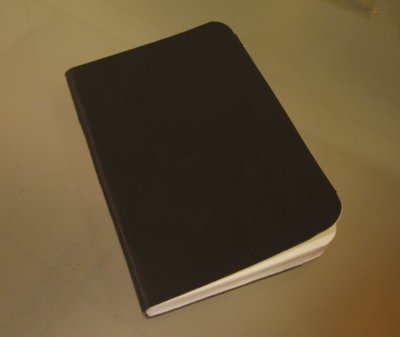
For those not in the know, this was what your basic Moleskine consists of:


It's nothing really special.  It's sixty pages of thin paper, sewed at the spine between two slightly larger pieces of board, usually black, although red, navy, and tan editions also exist.  They also come in different forms, like planners, small sketchbooks, and city guides.  But those are unimportant to the purpose of this blog post.  What I'm speaking of are the journals, which come lined, in a grid, or plain.  And I was excited as all hell when I found the plain.  And I never looked back, and and pleased as punch to say that I now have a stack of completed Moleskines in my studio, all filled to the brim with my mediocre art.

So what is it about these rather remarkable unremarkable sketchbooks that make me giddy?  It's probably because they are just so simply and unassuming, which makes them all the more flexible for one to do what they will to make them each a unique and individual piece.  Aside from the individual art inside, which is as different due to simple time and improvement, the exteriors are usually pimped out with all matter of stickers and assorted items that I encounter in my journeys.  Each sketchbook is a kind of snapshot, a peek into what was in my head, and where I was at the time.  And these sketchbooks are a cool medium to do that.

Granted, they do have their downsides.  They aren't nearly as durable as the other big beasts from Barnes and Noble, both in terms of their build and their paper.  They can't survive an overeager five year old, as I also discovered.  But they are really cool journals, and are more than versatile enough to tag along with me, no matter where I go.  And in the end, that's what matters.

Friday, August 10, 2012

Battle Royale As A Show Would Work Rather Well

Well, the news coming from the weekend was that the CW was in talks about turning Battle Royale into a television series.  While there are questions as far as to just how true to the original novel that the CW would stay, or even if they know what the book is about, turning Battle Royale into a TV series rather than a movie actually would be much more effective medium of translating the book into a visual presentation of the subject matter.  Here's why:

Allows For Fully Fleshed Narrative

The original book, Battle Royale, is not a small book by any means.  It's a rather large and detailed tome that covers the horror and depths of the central characters, and the wider world of the island, within it's handsome red cover.  And while the original narrative has been covered twice in both the movie and in it's subsequent manga, the movie, despite it's attempt to cover almost all of the main events that take place within the book, does have to cut corners.  As Stephen King once said about his truncated version of The Stand, and I'm paraphrasing this from memory, it's like a classic car, but with the paint and chrome sanded off.  It goes somewhere, but it isn't, you know, boss!  And that's how I felt about Battle Royale: The Movie.  The basic narrative of the story is there, with it's highlights, but a lot of the other little details that help develop the book, and allow for what I believe is a more enjoyable experience are missing.  A TV series, while lower budget, does allow for a fantastic medium from which to tell a story.

My favorite show at the moment, Breaking Bad, while blessed with excellent writing, wonderful characters, and great visuals, would still be an incredible movie.  However, it would also not nearly be the gripping thrill ride that I experience week to week if everything was forced to be condensed into a three hour flick.  And while this isn't a bashing of movies by any means, it is an admission that movies, while wonderful, are limited in terms of how much they are allowed to bring out and flesh out their subject material.

Allows For Focus On All Characters

Another great feature of the Battle Royale novel is that every student in the doomed class is given their own moment in the sun, whether it is their own portion of a chapter, or enough of a mention in the narrative that you do get at least a small piece of the person's essence, just enough for you to feel a slight twinge of pain or slight amusement whenever you see or feel that person die in the novel.  And while each and every student is shown whenever they've assumed their end in the film, you don't get that sort of emotional experience that you get in the book.  In the end, they're simply just mindless numbers.

However, in a television series, you would not only be able to show more than just mindless death, but also genuinely get to know each person, get the gist of each student in the class, and be able to mourn and honestly feel an emotional attachment to the characters that we see on screen.  But this doesn't just extend to the characters that are involved in what is called "The Program" in the novel, but also those who are in charge of the event.  From the average soldier that is charged with simply guarding the main fortress, to the parent who has suddenly realized that they will likely never see their child again, to the average man on the street, a television series would be able to weave each of the elements into the semi-voyueristic nature of Battle Royale, allowing for not just great story telling, but also a great way of advancing a narrative.

Allows For Exploration Of Entire Battle Royale Universe

The manga is even more expansive than the novel, with a great deal of original content covering both the characters backstories, as well as the wider world outside of the Program.  It makes for a richer piece of story telling, and allows for the creation of newer characters that don't have a stake in the actual program per se, but could in the future, whether they are in favor or opposed to the purpose of the Program itself.

Going back to Breaking Bad for a moment, the center of the show's universe is essentially the adventures of Walter White and Jesse Pinkman as the two attempt to survive their very dark world of meth cooking.  However, the show is not purely about them, as it often takes detours exploring the other characters of the show, whether it is the struggles of loyal wife Skyler White, the personal vendetta of Gus Fring, the various misadventures of Jesse's fellow band of stooges, to the machinations of Mike The Cleaner and Saul Goodman.  It's more than just the two central characters.  It's the entire ensemble and the whole wide universe that makes the show what it is.  And turning Battle Royale into Battle Royale: The Series would give the narrative such a canvas from which to work.

Allows For Multiple Classes Over The Course of Several Seasons

Finally, what a television series allows is for a series of multiple classes that find themselves victims of the program.  This wouldn't be something along the lines of Saved By The Bell, where we are forced to watch a class over the course of six or seven seasons as the gradually whack each other, but we are instead treated to a single class each season, with the potential for a larger conspiracy that seeks to end the slaughter by the end of the show's run.  It's an absolutely fantastic plot element, and keeps the central theme of the show going, but without the loss of a advancing, overarching narrative that will eventually come to a head in the final seasons.  Overall, it's perfect.

In the end, it all depends on who is placed in charge of the show, how willing the CW is willing to embrace Battle Royale's beautiful chaotic core, and how willing they are to choose not to try and adapt it toward a teen or tween audience (as many of the CW's shows are).  If done right, Battle Royale could be an instant classic.  But that's still a big If.

Monday, July 23, 2012

My Pumped Up Kicks

This past weekend, I did something that changed my life, at for the most part, my sense of comfort, my sense of self, style, and possibly even my sense of who I am will never be the same.

I bought two new pairs of boots.  The first is a pair of Timberland boots that I got on sale.  The second, a pair of Doc Marten's, will be replacing my much worn and much beloved pair of Sketcher's black work boots, which have been my default pair of kicks (well, those and my Chuck Taylor's) since 2005.

It's funny how attached we become to shoes.  For the most part, they aren't meant to be anything special.  They are to simply protect our feet from the assorted barbs, rocks, discarded gum, and possible bits of animal feces that we may encounter over the course of the day.  They are meant to provide extra support, in order to protect our tootsies from the abuse that concrete can inflict on you.  And even to provide some extra warmth when it's extra fucking cold outside, and snowfall decides to see just how difficult it can make life on you.

And yet, we love our shoes.  Women spend hundreds of dollars on a single pair of what they deem to be hot ass shoes.  Men take pride in making their various pairs of shoes shine, and look like new.  There are limited edition pairs of Chucks and Vans made with artwork designed by hip hop artists, graffiti artists, and comic book artists.  Hell, there are even sexual fetishes when it comes to the types of shoes a person will wear.

Perhaps it is simply that shoes are meant to be an extension of ourselves, one more way in which we can take something relatively simply and make it a symbol of our own individuality.  It can be something plain, simply, and functional, or something extravagant and off the wall.  It can be extremely sexual or extremely casual and laid back.  Shoes, despite their simply intentions, just are one of our ways to show off who we are.  They are our constant companions, our simplest friends.  They go with us on our adventures to various parts unknown.  They choose our outfits, and decide what looks good with what.  And, when we need them the most, they allow us to run for cover, run for our lives, or run to the next point of interest, with us laughing all the way.

And my Sketchers did that for me.  They were there for me when I went to Albuquerque numerous times.  They were there for me as I walked across the stage for my diploma.  They were there when my best friend and I explored Chicago.  They were there when I went to Vegas for the first time.  In almost all of my good times, that pair of simple black workboots were there, supporting me and taking me on my next adventure.

And now, after seven years, it's time to move on.  It's time to see what this new pair of boots can take me, what new adventures they'll allow me to experience in my 30's.  While I'm not confident that they'll last as long as my Sketchers have, perhaps they'll last me long enough to experience the next phase in my life, in all it's wonderful joy, sadness, heartfelt and heartache, all the gamut of positive and negative emotions that are to be had in this life.  We'll see, but they'll definitely be given the chance.

As for the Sketchers?  They're still in my closet, beat up, but still more than willing to take me to a few more places.  Like the best of old friends, they'll always be there for me, and always be ready to experience that next adventure.

Friday, July 20, 2012

Movie Review: The Dark Knight Rises


Before I begin, again, I'd like to send a moment to honor those that were senselessly murdered in last night's showing in Aurora, Colorado.  If you have anger, despair, or some other emotion that inspires you to even toe that line where you would do something, Stephen King said it best:  do something constructive.  Don't be an asshole.

And now, the review.


Synopsis (as spoiler free as I can make it, using the elements from the trailers):  Eight years have past since the end of the events of The Dark Knight.  Gotham has settled down into a relative peace.  Thanks to the decision to sacrifice The Batman in order to protect the work of Harvey Dent, Commissioner Gordon has virtually wiped out crime in Gotham, although the decision to do so weighs heavily on his soul.  As for the Batman himself, he has mostly become a memory, and urban legend.

All that changes with the arrival of Bane, a former member of the League of Shadows, who arrives to Gotham to essentially perform the same task that Ras Al Ghul desired to accomplish: Gotham's downfall.  Bane strikes at the fragile foundation that this peaceful Gotham has been built upon, and as the entire structure falls, and chaos reigns over the city, the city must once again turn to the protector that they once shunned, to try and save Gotham City, one last time.

Thoughts:   The Dark Knight Rises (DKR for the rest of the review), already was behind the eight ball with the expectations heaped upon it from the raging success of The Dark Knight (DK).  However, the film didn't shrink in the face of such stress, and rather than produce something that was merely average (Batman Forever, Terminator 3), or something that was absolutely steaming crap (Spider-Man 3, The Matrix Revolutions), DKR instead elevated itself to the rare platform of being a third film that successfully concluded the narrative with all the style and substance of it's predecessors, while leaving the audience feeling satisfied and saddened that the series is over, and wanting more.

The film draws upon several different Batman story arcs, mainly Knightfall and The Dark Knight Returns, with some elements worked in from No Man's Land and A Lonely Place of Dying worked into the mix.  However, these are only the most notable of the story arcs, as Nolan gathers elements from all of the Batman universe to create this movie that feels familiar, and yet is uniquely original.  There are even a few elements that are quite sneaky, but once you see them, you wonder how you missed them in the first place.

There are a great many themes at play in this film, but the two main ones being the importance of truth and loyalty. In the case of the former, the decision to hide the actions of both Harvey Dent and Rachel Dawes continue to be felt, and both still have a looming presence over the beginning of the movie. The consequences of the creation of their near sainthood weigh heavily on the two caretakers of the lie, Jim Gordon and Alfred Pennyworth. In both cases, the law of unintended consequences takes effect, as a very different outcome surrounds the original good intention of the action, and in both cases, the caretakers wonder if it was really worth it. As for loyalty, that also plays a large role in the film, as the relationships surrounding much of the early characters of DKR are ambiguous, and often come off as relationships of convenience rather than true loyalties. Only when times truly get dire do we see the intricate web of personal connections among the two different factions, including some that we never really do see coming.

Christopher Nolan does another dynamite job in this film. The visuals are stunning, maintaining that dark, gritty feel that has come to be identifiable with Chris Nolan, while also showing various other sequences meant to portray the depth of despair, the opulence of wealth, and the dark shroud in which the Batman operates all help contribute to the rich tapestry of the film. The music is fantastic, as can only be expected from Hans Zimmer, who hands down is probably one of a handful of movie composers that can legitimately tap into the soul of a film to draw out its inner melody.

Christian Bale reprises his role as Batman, making him the only member of what I believe George Clooney has dubbed “The Brotherhood” (I’m assuming from this interview on Grantland, linked here), to have portrayed the role for three films. And he certainly delivers, giving a solid performance in both halves of his role. And it also brings to mind a question explored somewhat in the comics, but never in the movies until the Nolan franchise, the physical and mental cost of being Batman. In his zeal to assume his ideal, Wayne has sacrificed and been drained of so much of himself, that at some point, there is a breaking point where he will turn up empty.

Anne Hathaway, who received a lot of scrutiny over her casting as Catwoman, delivers in her part of the film, being a sassy, morally ambiguous, that hides the shards of her humanity deep within herself in order to be able to do her job. Her action sequences are also well done, and while the outfit itself isn’t quite what one would have expected when the announcement of the role was released, it’s quite appropriate for what it’s original intended role was. Overall, she did a good job, and while I’m not quite ready to crown her as the greatest Catwoman ever, she just might be (especially considering the competition.)

Bane is excellently portrayed by Tom Hardy, and is an upgrade to the abomination that was placed onscreen in Batman And Robin.  He is close to what he was in the comic source material, that of a brute, but highly intelligent criminal, cut from the same cloth as Batman, but rather than sewn into the shroud of justice, he instead was sewn into the standard of evil.  He also symbolizes another theme in the film:  class warfare.  Without giving away too much, Bane shows little empathy for those that are in power or wealthy, and has no problems deposing and possibly disposing of them.  That said, I will admit, that it is in this department that there is some weakness in the film, but only from the standpoint that it was nearly going to be impossible to top Heath Ledger as the Joker, and almost any villain, despite how well he is implemented and created, would see slightly dimmer in the wake of that performance.


The supporting cast delivers as well, which is one of the strengths of the series that cannot be overstressed.  I loved Michael Caine in this movie, who shows again all the fatherly love that Alfred in the modern comics feels for Bruce.  In a way, you feel for him, as he knows that he cannot stop Bruce from donning the cowl again at some point, and likely wonders just how much longer he can continue to indulge Bruce's urge to place himself in danger, knowing that each night, there is a chance that the son that he never had will never return.  Likewise, Morgan Freeman returns, and again, serves as not just a trusted armorer, but also a capable operative of the Batman when necessary. There are even a few characters that you may recognize from previous films, which solicit a variety of reactions, including one that will make you laugh your ass off once you recognize him.


Gary Oldman and Joseph Gordon-Levitt also are solid in this film, and form a solid tandem.  Oldman is solid as always, and while I can't elaborate too much on his actions or role, let's just say that he continues to amaze as a man who is just as devoted and shackled to his city as the Batman himself.  Levitt is a welcome addition to the series, showing the melding of the two philosophies of both his mentors.  He's rapidly developing into one of the better rising stars of Hollywood, and I look forward to seeing his work that will be coming in the near future (I'm already making plans to see Looper.)

It was also neat to see the different technologies from the prior two films worked in.  While I'm not all that enthused about the design of the newest addition, the Bat, it does fit in with the function over style motif of the series, and, I will admit, it was an incredibly useful addition.  I loved seeing the return of both the Tumbler and The Batpod, and even what appeared to be the return of the Batman Begins batsuit, although due to sleep deprivation and a caffeine binge, I'm not certain if it was.

All in all, it was a worthy conclusion to the Dark Knight series, making it the rare trilogy in which all three of the films are legitimately solid movies in their own right. It is the final stanza of Nolan's grand opus, and in the end, we are left pleasurably in awe and probably better for the experience.  All in all, if more movies were made with the intent of telling a fantastic story, with all the quality writing and style that is available, maybe people wouldn't be so jaded with Hollywood.  It'll never happen, though, which makes these cinematic treasures all the more valuable.


Okay, Minor Spoiler:  There is no post credit scene, so go ahead and leave.